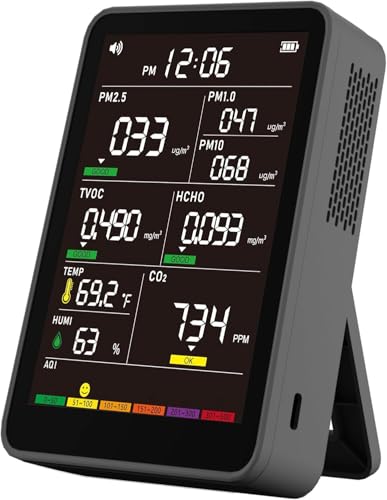
VOC monitoring follows an event-driven pattern tied to new material introduction, more like lead paint’s approach than radon’s periodic retesting schedule.
- Monitor VOC levels for several weeks to a couple months after any new material introduction.
- Ongoing continuous monitoring matters less for a settled home without recent new materials.
- Each new renovation or furniture purchase creates a new monitoring window.
- This event-driven pattern differs from radon’s periodic retesting schedule.
Monitoring After New Purchases or Renovation
Track VOC levels for several weeks to a couple months after any significant new material introduction (furniture, flooring, fresh paint), since this is when off-gassing is highest and declining — this is the primary monitoring window that matters.


Ongoing Monitoring Without New Introductions
For a settled home without recent new materials, ongoing continuous monitoring is less critical than for hazards with constant sources — though some households choose to keep a monitor running for general air quality awareness (VOCs, along with often PM2.5 and CO2 on multi-sensor devices).

Retesting After Any New Renovation or Purchase
Each new significant material introduction essentially resets the relevant monitoring window — retest/monitor again after any subsequent renovation or major furniture purchase, not just once at initial move-in. If you are still settling into a first home, the guide to VOCs for first-time homeowners covers what to do in that initial period, before any regular retesting cadence applies.
Retest When the Building Changes, Not Only the Contents
The event-driven pattern above is usually described in terms of new materials, but changes to the building itself belong on the same list. Air sealing and weatherization work, replacement windows, a new or resized heating and cooling system, or a bathroom or kitchen exhaust fan that has quietly stopped working all change how much outside air the house receives.
That matters because indoor concentrations depend on the rate of removal as well as the rate of release. A house that has been tightened without a corresponding change in ventilation can read differently with nothing whatsoever added to it. Weatherization work in particular is worth treating as a monitoring window in its own right, and it is the one most often missed because nothing new arrived through the front door.
Compare Like With Like or the Retest Says Nothing
A follow-up reading only means something against a baseline taken under comparable conditions: the same room, a similar season and outdoor temperature, the house closed up for a similar period beforehand, and the heating or cooling in a similar state. Heating season and open-window season are effectively different houses, and a comparison across them mostly measures the weather.
The practical habit is to record the conditions alongside every reading at the time you take it, because reconstructing them later is guesswork. Keeping one room with nothing new in it as a standing comparison point is also worth the small effort, since it gives every future reading something to be measured against inside the same house on the same day.
FAQ
Do I need to keep monitoring VOCs indefinitely in a settled home?
Not necessarily critical, though some households keep a multi-sensor monitor running for general air quality awareness. The key monitoring window is after new material introduction.
How long should the house be closed up before a reading?
Follow the instruction supplied with your device, or the protocol your assessor specifies, and then use the same closure period every time. Consistency between your own readings matters more here than any particular choice of period.
Should I retest if someone develops new symptoms?
Monitoring may help identify a source, but symptoms are a medical question first. Discuss them with a physician rather than relying on a consumer reading to rule anything in or out, and bring any measurements you already have to that conversation.
This is general guidance — for specific health sensitivities, more frequent or ongoing monitoring may be reasonable regardless of recent purchases.
These statements have not been evaluated by the Food and Drug Administration. This information is not intended to diagnose, treat, cure, or prevent any disease. Content is for informational purposes only and is not medical advice; consult a qualified healthcare provider before starting any supplement. As an Amazon Associate we earn from qualifying purchases.