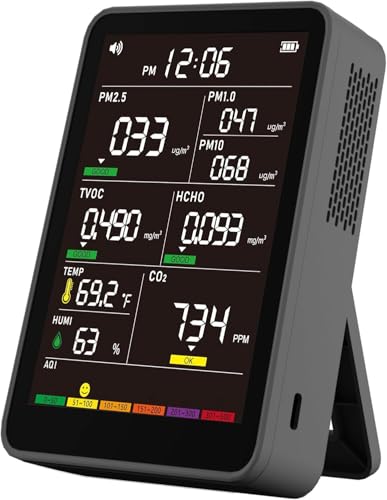
VOC monitor accuracy depends on proper placement and usage. These common mistakes are the most frequent causes of misleading readings.
- Place monitors in general living areas, away from direct ventilation sources, for representative readings.
- Allow proper sensor warm-up time per your device’s documentation before trusting readings.
- Take readings under consistent ventilation conditions for a meaningful trend comparison.
- Follow your specific monitor’s placement and usage instructions rather than assuming general familiarity.
Placement Mistakes
Placing a monitor too close to an open window or active exhaust fan gives an artificially low reading that doesn’t represent typical room conditions — for a representative reading, place the monitor in the room’s general living area, away from direct ventilation sources during the test period.
Ignoring Sensor Warm-Up Time
Many consumer VOC sensors need a warm-up period (ranging from minutes to hours depending on the device) after powering on before readings stabilize — check your monitor’s specific documentation rather than trusting an immediate reading right after unboxing or restarting.
Testing Immediately After Ventilating
Taking a reading right after opening windows or running exhaust fans captures a temporarily diluted level, not your home’s typical baseline — for tracking the actual off-gassing trend, take readings under consistent, comparable conditions (same ventilation state) across your monitoring period.


Mistaking Ordinary Spikes for a Problem
A great many alarming readings turn out to be an ordinary household activity happening a few feet from the sensor. Cooking, particularly frying, along with spray cleaners, aerosols, air fresheners, scented candles, alcohol wipes, nail polish and remover, permanent markers, and solvent-based adhesives will all push a reading up sharply while they are happening.
What distinguishes these from something worth acting on is shape rather than height. A spike that rises quickly, has an obvious cause and returns to its previous level once the room has aired is the sensor working correctly. A level that has settled higher than it used to be and stays there across days, with no particular activity attached, is the pattern actually worth investigating. Noting what was happening in the room when a spike appears is the fastest way to stop chasing them.
Comparing Against the Wrong Baseline
A single reading in isolation means very little, because these devices report on a scale that is not comparable between brands and there is no universal number that separates fine from concerning. What makes a reading interpretable is having something of your own to compare it against.
Two baselines are worth establishing early. Take the monitor outdoors, away from traffic and combustion, to see where the low end of its scale sits, and record what an ordinary undisturbed room reads before whatever you are about to buy or renovate arrives. After that, compare like with like: the same room, the same position, and a similar ventilation state. Readings taken immediately after airing a room, or in different seasons, are not comparable to each other, and comparing your number against a figure quoted for someone else’s device is not meaningful at all.
FAQ
Why did my VOC reading spike right when I turned the monitor on?
This is likely sensor warm-up — many devices need time to stabilize after powering on. Check your specific monitor’s documentation for the expected warm-up period.
My reading spikes whenever I cook. Is that a problem?
That is normal and it means the sensor is responding as it should. Cooking releases compounds the sensor detects. What matters is whether the reading returns to its usual level once the kitchen has aired, which it generally will with extraction or an open window.
What counts as a normal indoor reading?
There is no single number, because manufacturers scale their outputs differently and a figure from one device does not transfer to another. Your own baseline for that room on that device is the only comparison that reliably means anything.
How long should I log before drawing a conclusion?
Long enough to see past daily activity, which in practice means at least several days and preferably a couple of weeks when tracking whether a new item is still emitting. Single readings are the least informative use of a monitor you own.
Consistent placement and ventilation conditions across readings give the most meaningful trend comparison over time.
These statements have not been evaluated by the Food and Drug Administration. This information is not intended to diagnose, treat, cure, or prevent any disease. Content is for informational purposes only and is not medical advice; consult a qualified healthcare provider before starting any supplement. As an Amazon Associate we earn from qualifying purchases.